
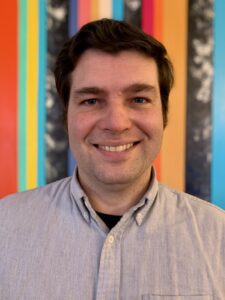
 MARKIAN DOBCZANSKY
Independent Scholar and Associate, Harvard Ukrainian Research Institute
Professional Interests: 20th-century Ukrainian history, Soviet history, cities, nationalism, Cold War
When did you join the Shevchenko Scientific Society? What inspired you to become a member of the Society?
After moving to New York City in 2017 for a post-doctoral fellowship, I applied to join the Shevchenko Scientific Society out of a desire to find a scholarly community. Several mentors and colleagues were already members and I enjoyed attending events at the Society’s building in the East Village. As I learned more about the organization, I started to notice the Society’s logo frequently in books relevant to my research, including many important document collections and monographs published in Ukraine. In 2021–2022 I worked for NTSh-A as an administrative associate and was continually impressed by the breadth of members’ expertise and commitment to scholarship and Ukrainian culture. Now, as a member of the Board, I look forward to advancing the organization’s mission, expanding its membership, and bringing our work to new audiences.
How did your interest in Ukrainian history, culture, and society influence your career path? What are your current projects and research related to Ukraine?
A summer at the Harvard Ukrainian Summer Institute as an undergraduate student opened my eyes to the fields of Ukrainian history and culture. After eight weeks of studying modern Ukrainian history and literature as stand-alone subjects, I changed my major to history and began to consider graduate study as a possible next step. The very next year the Orange Revolution helped me understand how much was still at stake in Ukrainian politics and my existing interest became a force determining the direction of my career. My interest in and study of Ukraine has taken me to the Kennan Institute in Washington, DC, to California for Ph.D. study at Stanford University, postdocs in Toronto and New York City, and most recently to the University of Illinois Urbana-Champaign, not to mention the years I spent doing research in archives across the former Soviet Union. Today I am working on a book manuscript in Ann Arbor, Michigan, where I look forward to being an active member of the Detroit chapter of NTSh-A.
How has the ongoing Russo-Ukrainian War impacted your professional interests and priorities?
When I began working for the Shevchenko Scientific Society in 2021, Russia’s war against Ukraine had already been going on for seven years. The full-scale invasion on February 24, 2022 seemed, nevertheless, to have been a wake-up call for the world. At NTSh-A, we mobilized the resources we had—a deep pool of expertise, experience, and insight—to inform the public in the U.S. about the existential stakes of Russia’s war against Ukraine. In response to the deep need among Ukrainian academics for support during wartime, we also created the Shevchenko Emergency Fund to fund fellowships. The first grants went out in 2022 and the second round was awarded in 2025. Working with President Halyna Hryn and other members of the Society in these tragic times for Ukraine was just about the most meaningful and important work I have ever done. The war’s transformation of international politics made Ukraine an ever more important part of my teaching on Soviet history, European and Eurasian studies, and EU politics. While at the University of Illinois, I also helped create the Illinois Ukrainian Studies Committee, which coordinates Ukraine-related activities across campus.
What are the ways to communicate Ukrainian messages to international audiences? How can Ukraine become more connected to communities around the world?
Ukrainians have become increasingly effective at communicating their messages to international audiences in recent years. A younger generation in Ukraine has been leading the charge in developing new projects and collaborations with colleagues in Europe as well as in North America. U.S.-based academics working on Ukraine have also taken on leadership roles in scholarly organizations such as ASEEES. That said, disinformation campaigns, ingrained stereotypes, and a “Russia-first” mentality still impede public understandings of the war. The need to publicize Ukrainian perspectives remains acute. Including genuine Ukraine experts in the media conversation, bringing Ukrainian authors and artists to your local community, and contacting American leaders at all levels of government are just a few of the ways to get the message out and help the public understand the stakes of the conflict.
What career advice would you give to new members of the Shevchenko Scientific Society in the United States?
When thinking about your career, think about the long term. You never know where you will end up or who you will work with or how that will influence your trajectory. Although scholarly and creative work is often highly solitary, not all work that scholars do is individual. Collaborating with others can greatly increase the impact of your work. The network effect of an organization like the Shevchenko Scientific Society is substantial and can be quite powerful.