
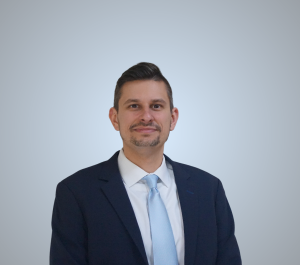
 MARK TEMNYCKY
Freelance Senior Geopolitics Contributor at Forbes, Nonresident Fellow at the Atlantic Council’s Eurasia Center, and Adjunct Professor at Loyola University Chicago
Professional Interests: U.S.-European transatlantic relations, Eurasian affairs, defense policy, energy security, Ukrainian football
When did you join the Shevchenko Scientific Society? What inspired you to become a member of the Society?
I joined the Shevchenko Scientific Society in July 2021. Several of my mentors and colleagues were already members, and I wanted to be part of an organization dedicated to scholarship and expertise on Ukrainian and Eurasian affairs. The Society’s long history of supporting Ukrainian scholars made membership especially meaningful to me.
How did your interest in Ukrainian history, culture, and society influence your career path? What are your current projects and research related to Ukraine?
As a Ukrainian-American, I grew up with a strong connection to Ukraine. During my undergraduate and graduate studies, I wrote extensively about Ukrainian and European history and politics for my history, political science, and international relations assignments. Additionally, in the summer of 2016, I worked at the Verkhovna Rada, Ukraine’s parliament, as a parliamentary trainee for the Committee on Foreign Affairs.
I also began freelance writing in graduate school, and my first article, published by Forbes in February 2016, examined the correct usage of “Ukraine” versus “the Ukraine.” Since then, I have written hundreds of articles for American and European news outlets and think tanks on national security, foreign policy, energy security, defense policy, politics, economics, and sports. I later joined the Atlantic Council’s Eurasia Center as a nonresident fellow in December 2021.
Today, I write regularly about Russia’s ongoing full-scale invasion of Ukraine, as well as European defense, energy security, and Ukrainian football. I also teach graduate students online as an adjunct professor at Loyola University Chicago’s School of Continuing and Professional Studies.
Please share your thoughts on how the ongoing Russo-Ukrainian War is reshaping how Ukraine is known in and understood across international communities.
For much of its modern history, Ukraine was viewed through a Russian lens, as a former Soviet republic rather than a nation with its own language, culture, and history. Even its name was frequently misused as “the Ukraine,” the subject of my first article for Forbes. Many non-Ukrainians compared Ukraine to Russia, mistook Ukrainian history for Russian history, and assumed the Ukrainian language was a dialect of Russian.
Russia’s full-scale invasion in February 2022 changed that. Governments, media outlets, and universities now recognize Ukraine as a distinct nation, and interest in Ukrainian history, literature, and culture has grown. International media and institutions have also adopted Ukrainian spellings of Ukrainian cities, such as Kyiv, Odesa, and Kharkiv, in place of the Russian Kiev, Odessa, and Kharkov.
Ukraine is now seen as a strategic actor, and its leadership in drone warfare and battlefield innovation informs defense planning across Europe and NATO.
The challenge is keeping this attention as war fatigue sets in. Organizations like the Shevchenko Scientific Society play a vital role in ensuring that Ukraine is understood through its own scholarship and voices.
What are the ways to communicate Ukrainian messages to international audiences? How can Ukraine become more connected to communities around the world?
Ukraine’s message resonates most when it is told through people rather than statistics. International audiences connect with personal stories, whether from soldiers, volunteers, artists, athletes, or families rebuilding their lives. Ukrainian experts and journalists should also have a regular presence in international media so Ukraine is explained by Ukrainians rather than others. This is one reason I write regularly: to help international audiences understand Ukraine, as well as other countries in the region.
It also helps to show audiences why Ukraine matters to them. Ukraine’s security is tied to Europe’s security, its agriculture affects global food prices, and its defense innovations are shaping how allied militaries plan for the future.
Culture and sport are powerful bridges as well. Ukrainian literature in translation, music, film, and football reach people who may never read a policy paper. Finally, the diaspora and organizations like the Shevchenko Scientific Society can connect Ukraine to local communities through lectures, exhibitions, academic exchanges, and partnerships with universities abroad.
What career advice would you give to new members of the Shevchenko Scientific Society in the United States?
Build relationships with mentors and colleagues. Many of the opportunities in my career came through people who offered guidance, made introductions, or encouraged me to take the next step. That is also how I found the Shevchenko Scientific Society.