
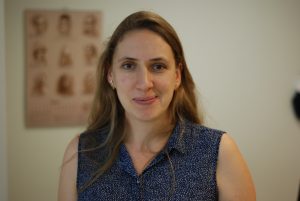
ILONA SOLOHUB
Current Position: VoxUkraine editor
Professional Interests: Economic policy
When did you join the Shevchenko Scientific Society? What inspired you to become a member of the Society?
I joined the NTSh-A in early 2022, when I relocated to the U.S. One of my friends recommended that I become a member. I would like to be part of the Ukrainian research community in the U.S., both to receive information on the latest research and to contribute to scholarly discussions.
How did your interest in Ukrainian history, culture, and society influence your career path? What are your current projects and research related to Ukraine?
Since I work for a Ukrainian NGO, all my research interests are related to Ukraine. I write analytical articles on policy and legislation and conduct data-based research. I have contributed to two books: From The Ukraine to Ukraine (ibidem) and Reconstruction of Ukraine: Principles and Policies (CEPR).
Please share your thoughts on how the ongoing Russo-Ukrainian War is reshaping how Ukraine is known and understood across international communities.
People in different countries perceive Ukraine very differently. Countries closest to Ukraine and Russia, such as the Baltic states, understand that their own survival depends on Ukraine’s continued resistance. Countries farther from Ukraine only discovered it on the map in 2022; before that, they had no particular interest in Ukraine. Many countries in the developing world mostly did not notice anything. I am glad that Ukrainian studies are currently developing at U.S. universities. Unfortunately, many intellectuals still view Ukraine through a Russian lens.
What are the ways to communicate Ukrainian messages to international audiences? How can Ukraine become more connected to communities around the world?
I believe the most effective way to reach audiences in different countries is through reputable media outlets in those countries. The Ukrainian diaspora is an asset in this respect; it could help develop horizontal connections, for example, between students and professors, between researchers and media professionals, etc. I believe Ukrainians should communicate not only about the war and current events but also present our culture more broadly, for example, by translating Ukrainian classics, organizing art exhibitions, film screenings, etc.
What career advice would you give to new members of the Shevchenko Scientific Society in the United States?
Try to do the right thing; eventually, it pays off.