
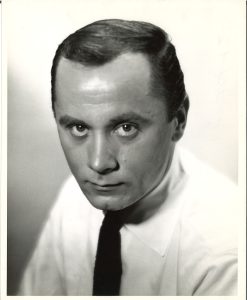
The Shevchenko Scientific Society recently completed processing the papers of Ukrainian-American actor William Shust through a grant from the Documentary Heritage Program, a statewide grant program administered by the New York State Archives to provide financial support to not-for-profit organizations that hold, collect, and make available New York State’s historical records. The Shust papers are now accessible to researchers and members of the general public interested in exploring the distinctive intersection between the performing arts and the experiences of immigrant communities in New York City.
Born in New York City to Ukrainian immigrant parents, William Shust grew up in the area of Manhattan’s “Little Ukraine.” In 1945, he graduated from Seward Park High School, which counts performing arts luminaries such as Tony Curtis, Estelle Getty, Jerry Stiller, Walter Matthau, and Luis Guzman among its alumni. He went on to attend Fordham University, where he earned a B.S. in Marketing in 1949 and an MFA in Theatre in 1954.
Shust’s career as an actor lasted for over six decades, during which he was actively involved with Broadway and Off-Broadway theater in New York and regional theater across the United States and Canada. He received great acclaim in the early 1960s for playing the leading role of Emile in the first-ever production of The Egg in the United States — theater critic Henry Hewes named The Egg the best play of 1961-1962 on the strength of Shust’s performance.
One of Shust’s most notable successes was his longtime portrayal of Anton Chekhov, a Russian writer with Ukrainian lineage, in the one-man show Chekhov on the Lawn. Beginning in 1972, Shust performed Chekhov on the Lawn across the United States and Great Britain for close to two decades, earning rave reviews and winning the Best Performance Award at the Edinburgh Festival Fringe in 1980. In 1990, he became the first American actor to perform in Yalta (present-day Russian-occupied Crimea) when the USSR invited him there to perform Chekhov on the Lawn.
Other productions Shust was involved in include Bertolt Brecht’s Arturo Ui (first production on Broadway, directed by Tony Richardson), The Owl and the Pussycat (Broadway, directed by Arthur Storch), Clifford Odets’ The Country Girl (Broadway, directed by John Houseman), The Misanthrope (Theatre East), Right You Are, Ghosts, Lovers (Roundabout Theatre), Julius Caesar (New York Shakespeare Festival), Agamemnon, Electra, Trojan Women (Theatre Marquee), Look Back in Anger (41 Street Theatre), Count Dracula (Equity Library Theatre), Hedda Gabler (The Cubiculo Theatre Company), The Taming of the Shrew (Phoenix Theatre), and The Scarlet Letter (Gene Frankel Theatre). He also acted in various films, television programs, and commercials, including small roles as the psychologist Dr. Fisher in Dark Shadows and Patrick Henry in the 1976 PBS historical drama miniseries The Adams Chronicles.
The papers of William Shust were donated to the Shevchenko Scientific Society by Stefa Charczenko, a good friend both of Shust and of the Society. The collection had been in the archives for several years but was difficult to use because it lacked organization and description, making it impossible to tell what was in all of the boxes. In order to better preserve Shust’s papers and make them accessible for generations to come, a project archivist, Lee Jutton, was hired through a grant from the Documentary Heritage Program. She conducted an initial inventory of the materials, created a processing and arrangement plan, rehoused materials out of acidic folders and envelopes, sleeved photographs, and physically arranged the parts of the collection that had little to no preexisting organization.
During processing, a collection of theatrical memorabilia related to Robert Bruce Mantell, Vaughn Deering, Edwin Booth, and other notable actors from the late 19th and early 20th centuries was discovered among Shust’s papers. Because this collection concerns people who were active on stage before Shust was born and is largely unrelated to his own career, it was a surprising discovery, and one that would not have occurred if the Shust papers had remained unprocessed.
The extent of the Shust papers is approximately 30 linear feet, including oversized materials. The majority of the collection consists of materials relating to Shust’s professional career as an actor, including correspondence with individuals and professional organizations and project files filled with clippings, contracts, photographs, programs, and other materials from productions Shust was involved in. There are also scripts for plays, television productions, and other projects; publicity materials, many of which were designed by Shust; writings, including a proposed television script about Taras Shevchenko; and other professional records. In addition, there are personal records related to Shust’s family, education, and involvement in the Ukrainian-American community. There are also audiovisual materials, props, realia, and books.
Processing and description of the William Shust papers was made possible in part by a grant from the Documentary Heritage Program of the New York State Archives, a program of the State Education Department.