
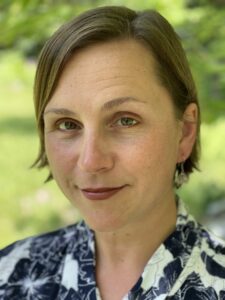
MARIA SONEVYTSKY
Associate Professor of Anthropology and Music, Bard College
Professional Interests: Ukrainian folk and popular musics, childhood studies, Crimean Tatars and Indigenous politics, environmental humanities, socialist feminisms, Yiddish and Ukrainian language folk songs from shared territories, theories and critiques of decolonization
When did you join the Shevchenko Scientific Society? What inspired you to become a member of the Society?
I joined in 2021 at Virko Baley’s kind invitation. The Society was expanding its membership, and I wanted to be part of this historic scholarly organization as it breathed new life into the rigorous study of Ukraine.
How did your interest in Ukrainian history, culture, and society influence your career path? What are your current projects and research related to Ukraine?
I hold a Ph.D. in ethnomusicology, or the anthropology of music, and my research has primarily centered on Ukraine. I pursued the scholarly study of Ukraine since my undergraduate years, though admittedly with some considerable ambivalence at first. But as a child of the post-WWII Ukrainian diaspora, I was always attracted to the place. My family had reconnected with branches of our family there beginning in 1991, and I had the opportunity to travel to Ukraine multiple times as a child in the 1990s.
As an undergraduate, I was especially interested in learning what I did not know about Ukraine from my diaspora upbringing. This led me to develop a keen interest in the Crimean Tatar community, and to dabble in Yiddish language study (an interest I’m further cultivating now in one of my song-based research projects) and klezmer music.
I happened to arrive at Columbia University when Ukrainian-focused offerings were expanding. The late Cathy Nepomnyashchy, whose scholarly expertise had largely centered on Russia, was the director of the Harriman Institute at the time and became an early champion of Ukrainian (and Georgian) studies. She was my undergraduate academic advisor. In retrospect, it all feels like kismet: to be able to take Ukrainian literature classes with Vitaly Chernetsky—who opened my eyes to the diversity of Ukrainian literature and inspired me then with his experiments at the Nuyorican Poets Café—and the late Soviet historian-turned-Ukrainianist Mark von Hagen. I also took a Modern Ukrainian History course with Frank Sysyn—incredibly intimidating as an undergrad! —where I was one of two students; the other was Rory Finnin, who was completing his Ph.D. (I wrote my first 25-page seminar paper for Prof. Sysyn, on literary and musical currents in late Soviet Ukraine—at the time, I was extremely taken with the literary performativity of Bu-Ba-Bu.)
As a graduate student, I was trained as an anthropologist of music, and my first research projects were primarily ethnographic. More recently, for a range of practical and personal reasons, my work has moved explicitly to the borders of historical and anthropological/ethnomusicological research; I am spending much more time in archives. I hope to return to more extensive ethnographic research in the future, especially when travel to Ukraine becomes easier again and when my children are a bit older.
Currently, I am prioritizing the research and writing of my third book, which is about the Kyiv Palace of Pioneers and the attempt to discipline Soviet Ukrainian children through musical practices.
How has the ongoing Russo-Ukrainian War impacted your professional interests and priorities?
The ongoing Russo-Ukrainian war has profoundly impacted my professional priorities.
At the most immediate level, my first instinct after the full-scale invasion of 2022 was to turn to my closest Russianist colleagues in the U.S. for solidarity. The responses were mixed, in ways that I am still learning to understand. Some made it easy to sustain dialogue and friendship; others revealed a degree of chauvinism or disregard for Ukrainian suffering that quite literally shocked me. On my journey through academia, I had occasionally encountered condescension—the backhanded compliment that my research on Ukraine was “actually good,” that kind of thing—but the existential crisis facing my friends, family, and colleagues in Ukraine made me far less tolerant of such attitudes, especially in their Russian chauvinist form. I have more to say here, as I am sure many Ukrainianists do, and this is not the place to air that out – but they may merit collective reflection at some point.
The shocking audacity of Russia’s attempt to take Kyiv redirected my focus in the immediate aftermath of the invasion. In addition to raising funds to support Ukrainian humanitarian and defensive needs wherever possible, I wrote a short article on epistemic imperialism and dedicated myself to more thoroughly interrogating how Russian ideas of cultural “greatness” intersect with revanchist violence. The stereotypes I encountered about Ukrainians—past and present—also recommitted me to a longstanding interest in Ukrainian critiques that hold the delicate line between critiquing Russian and Soviet empires, and interrogating the violence and hypocrisies of liberalism and capitalism. With colleagues, I developed a course on “Ukraine and Decolonial Thought” to examine this more thoroughly. It attracted students with a wide variety of postcolonial perspectives—Jamaica, Pakistan, Afghanistan, and beyond—to debate how theories of decolonization, postcolonialism, and decoloniality can illuminate, or fail to illuminate, aspects of Ukraine’s past and present.
I was able to resume writing on my second book in the spring of 2022. Honestly, I was shocked that people were still willing to talk to me, work with me, despite the electricity outages and air raid sirens. I know this is a common story for those of us working in Ukraine: the awe at the resilience of people whose lives have been so violently disrupted and constrained by the Russian assault over the last four years. That book, on late Soviet Ukrainian punk, was published in 2023. Establishing a connection to interlocutors on the current research has proven much more difficult.
What are the ways to communicate Ukrainian messages to international audiences? How can Ukraine become more connected to communities around the world?
There is a paradoxical relationship between deep knowledge of and immersion in Ukrainian studies and our ability to reach outwards. I am always trying to find ways to effectively write and think across various divisions—ethnic, national, religious, geo/political—and I am grateful for the models that exist among my networks in both academic and activist spaces where this work is done well.
What career advice would you give to new members of the Shevchenko Scientific Society in the United States?
I think it is very difficult to issue blanket advice with respect to anything in academia, but one thing I can offer is that, as scholars, we should select research topics that speak to questions of deep personal interest—even if future readers might have no idea that they have a personal resonance to the author.